
Guides · Reviewed 19 October 2026 · 6 min read
Build support: independent help while the work is underway
Most problems on a build are not dramatic. They are quiet: a payment coming due while work has slowed, a small change that was never priced, a week of silence when you expected the next stage. Build support is SureBuild's independent presence while the work is running — a second set of eyes on the job, on your side.
When homeowners call for it
- Ahead of a stage payment — you want someone to look at the work before the money goes.
- When variations start appearing — the quote said one thing, the site is heading another, and it needs pricing properly.
- When the build and the paperwork drift apart — you want the job checked against the drawings, schedule and contract, not just the latest message.
- When you simply want to understand where you are — a written picture of progress, what is next and what needs deciding.
What build support covers
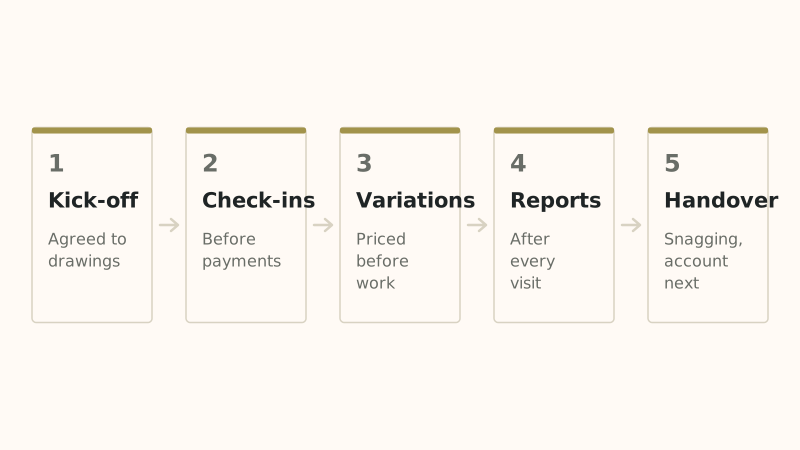
- Site visits with a written report after each one — what was seen, what is progressing, what needs attention.
- Stage checkpoints before payments become due, matched to the schedule in your agreement.
- Variation checks — changes priced and agreed in writing before the work happens, not after the invoice lands.
- A running eye on quality and progress between the milestones, so small issues stay small.
- A route to a snagging inspection and a final account review as the build reaches handover.
Why it pays for itself
The pattern that ruins projects is rarely the big disagreement on day one — it is the accumulation of small gaps between what was agreed and what got built, noticed too late to fix cheaply. A regular independent check keeps those gaps on your desk while they are still conversations rather than disputes.
How it fits the rest of the journey
The support starts best as early as it can: a quote reviewed before signing feeds straight into the stage checkpoints, which feed the snagging inspection and final account review at the end. Homeowners do not need all of it — most start with the piece their project needs next, and add from there.
Questions people ask us
- No — it is useful early for big builds and late for smaller works that have hit a rough patch. Send what you have and the help is scaled to the job.
- In practice most builders welcome an informed homeowner, and the earlier they see the structure the better the paperwork flows. The visits are yours; the report is yours.
- Plain English: what was seen on the day, the stage status against your schedule, anything to raise with the builder, and what to decide next. No jargon for the sake of it.
- Yes — that is a common starting point. The first visit turns the uncertainty into a written picture of where the job really stands.